Showing posts with label John Hale. Show all posts

Monday, October 13, 2014

The One-Armed Fiddler

John E. Hale with infant children
October 13, 2014

Dear Constant Readers,


This is the seventh installment in an ongoing series of posts from which I hope will form the first draft of a book.  The working title for this book is, "Confessions of a Second Grade Failure."  It is a coming-of-age memoir about growing up in Kingsport, Tennessee during the 1960s and early 1970s.


And don't forget - if you subscribe to receive my blog posts by email before October 15, you will automatically be registered in a contest to win a new Kindle reader from Amazon.  For more details about the contest and how to subscribe, please read this post.


Cheers,


Stephen


P.S. Even though I do proofread my work before publishing on this blog, occasionally a grammatical error or misspelling will elude my notice.  I do have a more objective proofreader, my wife, Lynn, but she usually proofs it after it has gone out to you, the reader.  When I finish a blog, I transfer what I have written into chapters kept in a text document.  These blog posts help shape what I will soon submit to the literary agent.  So, if you find grammatical errors or misspellings, feel free to share them with me so that I may correct them.  Right now I am writing to generate material and content for the book, so I am somewhat less attentive to the polishing process that goes into finished material.  Thanks for your understanding and your participation.


_______________

Confessions of a Second Grade Failure

The One-Armed Fiddler

While my grandmother, Cora, was the patient nurturer in the family, my grandfather, John E. Hale, was the one more likely to lay down the law with his children. Cora told how one day Papaw gathered up all the boys in the family and took them out onto the front porch. Their house was just off the Norton Road near Main Street in Wise. They lived right at the center of town. The tallest building in Wise at that time was the county courthouse and the jail right beside it, which one could easily see from the Hale’s front porch. Papaw raised up the remaining stump of his right arm and pointed toward the jail saying, “Boys, you see that jail? I’ve got just one piece of advice - if you get yourselves in there, then you’re also going to have to get yourselves out.”

The reason for this warning may have been triggered by one of the Hale boys many pranks. Like the time they took the Mayor’s wagon apart, carrying all the pieces and rebuilt the wagon completely intact on top of the Wise Courthouse.

John Hale, in general, was strict with his children in matters of right and wrong. This was both a bent
Talton "Bad Talt" Hall
in his character, and also a result in his years as a lawman. In September 1890, he was appointed by Judge W. T. Miller as a “Special Policeman” for Wise County. He was also a member of the Home Guard in Big Stone Gap, a self-appointed group organized to police the town and bring order to the area. In both his capacity as a Special Policeman and a member of the Home Guard, he participated in the manhunt and capture of the infamous Kentucky outlaw, “Bad” Talt Hall. Hall, implicated in a number of murders over the years, was ultimately brought to justice after killing Police Chief John Hylton of the town of Norton, Virginia in 1891. After he was caught, he was tried, convicted and hanged in 1892.

Papaw also participated in the search and capture of fellow lawman gone bad, “Doc” Marshall B. Taylor, who was a second cousin of mine. He was also known as the “Red Fox.” This nickname came to be associated with Taylor because of red hair and beard, and also for his stealth in tracking down outlaws. Taylor was a mountain mystic and seer, who had studied the works of Swedish philosopher and theologian, Emanuel Swedenborg, and claimed to be able to commune with the dead and the heavenly host. He was also a part-time preacher (at times Methodist, other times Baptist), physician and herb doctor (hence his title, “Doc”), and he also served as a U. S. Marshal.

Notice that "Doc" Taylor seems to
be holding both a Bible and a gun.
One of Taylor’s responsibilities as marshal was to roust moonshiners in of the hills of southwestern Virginia and to put them out of business. In this capacity, as one could imagine, he made a number of enemies. One, in particular, was a moonshiner by the name of “Old” Ira Mullins, who had sworn to have Taylor killed, going so far as to put a $300 bounty on his head. Taylor decided to take matters into his own hands and kill Mullins first. On May 14, 1892, Taylor and two brothers, Calvin and Henan Fleming, lay in wait in Pound Gap (henceforth known as the “Killing Rock”), a break in the mountains between Virginia and Kentucky. Sadly, Ira was not alone as he traveled - he had his whole family with him. This did not deter Taylor and the Fleming boys. Shots reigned down upon the Mullins family, killing all but two of them - Ira’s young son, John, and Mullins’ daughter-in-law, Jane. Though Taylor and the Flemings attempted to disguise themselves, wearing bandanas tied around their faces, the two remaining members of the Mullins’ clan were still able to identify them.

After this massacre, Taylor went into hiding. Sheriff John Miller organized a posse of twenty-two men, including my grandfather. The manhunt lasted for several days. Taylor was finally captured after he snuck onto an outgoing train in Norton to Bluefield, West Virginia. He was apprehended there and brought back to Wise where he was placed into custody in the county jail. Ironically, Taylor’s cell was right next to Talt Hall, whom he, in his capacity as U.S. Marshal, had helped hunt down and arrest just a year previous. Not only did my grandfather participate in the manhunt for Taylor, he helped guard him as well. Grandpa was present the day that the jury found Taylor guilty of murdering the Mullins family, and he was also present when Taylor was hanged outside the Wise Courthouse.

The day of the hanging for "Doc" Taylor, aka Red Fox
Since Taylor was an ordained preacher, he asked for and received permission from the court to preach his own funeral sermon and to offer communion before he was hung. He preached for over two hours to a large gathering of people. When he finally offered the sacrament, no one came forward to partake of the elements except his wife, Nancy. He also requested that his wife make him a new linen suit to wear to his hanging - a completely white suit, symbolizing Taylor’s belief in his own inward purity. She also made him a white hood, instead of the traditional black one, which was to be placed over his head when he was hung. His last request before death was that his body not be buried immediately, but rather to lie in state in his family home for three days. Why three days? Why, of course, he predicted that in three days time, he would rise out of his wooden coffin, fully restored and prepared once again to preach the Gospel. After his hanging on October 27, 1893, per his instructions, Taylor was laid to rest in his white suit and his coffin placed in his home for three days. To no one’s surprise, he remained dead. Taylor’s body was then taken to the woods on a ridge overlooking Wise and buried in an unmarked grave.

First Edition, 1908
In 1908, the Appalachian author, John Fox, Jr. published a novel, The Trail of the Lonesome Pine, The Trail of the Lonesome Pine was made into a movie in 1938, starring Henry Fonda. It was also later transformed into an outdoor drama, which has been performed each summer in Big Stone Gap for over fifty years, and become the official state outdoor drama of Virginia. My grandmother never saw the production itself. She said that she didn’t need to because she already knew the story by heart.
based in part on the stories of “Bad” Talt Hall and “Doc” Taylor. It was one of the top-ten bestsellers in the U.S. both in 1908 and 1909. The main character in Fox’s novel was none other than John “Jack” Hale - “Jack” was my grandfather’s nickname. Though the character is a composite and fictional, he is based to some degree on Papaw. Fox and my grandfather were close friends for many years. They had served together in Home Guard in Big Stone Gap and participated together in the hunts for Hall and Taylor. Mamaw said that Fox would drop by the house every now and then to visit with Papaw, often staying overnight. It was during these times together sharing memories and tales of Wise County that Fox gathered stories and background for his novels.

***

My grandfather was born July 2, 1862 in Whitesburg, Tennessee to Samuel Lane Hale and his wife, Catherine Brewer. Mamaw told us that Papaw’s earliest memory was of his father lifting him up to sit atop the split rail fence of their farm so that he could see soldiers marching back to their homes following the Civil War. Dressed both in the Blue and the Gray, the Hales and other families from east Tennessee fought on both sides of the conflict.

Following the Civil War and Reconstruction, the Hale family suffered economically during this tumultuous period, only to face the national depression in the early 1870s. When coal was discovered in southwest Virginia, many Tennesseans left their homes to start over. in 1880, Samuel and Catherine Hale moved their entire family - all twelve children - to Powell Valley, Virginia, with Big Stone Gap at its south end and the city of Norton to its north.

One of many of my grandfather’s talents was as a mechanic. With the right tools, he could build just
about anything. A fellow from Wise County, Morgan E. Lipps, wrote an article for the Kingsport Times-News about an early incident with my grandfather in 1885 in Powell Valley. Lipps was in his yard near the main road when, in the distance, he saw a man’s head high up in the air. The man was riding something, but it didn’t look like any horse he had ever seen: “That outlandish contraption rolled right up to our gate and sure enough it was part man and part wheels tangled up together... The man part was John Hale, son of Sammy Hale.” In hindsight, Lipps said that the thing that my grandfather was riding was a bicycle, but back then, he had no words for what it was. He said, “This man Hale evidently had found an old buggy wheel and one off a discarded wheelbarrow. He had joined the two together with some sort of frame with the buggy wheel in front with a makeshift saddle mounted high up. John was riding that thing big as Jake.. It was the first bicycle ever manufactured in Wise County and the first one rode.”

John, like his father, Samuel, and his grandfather, Thomas, before him, was apprenticed in art of
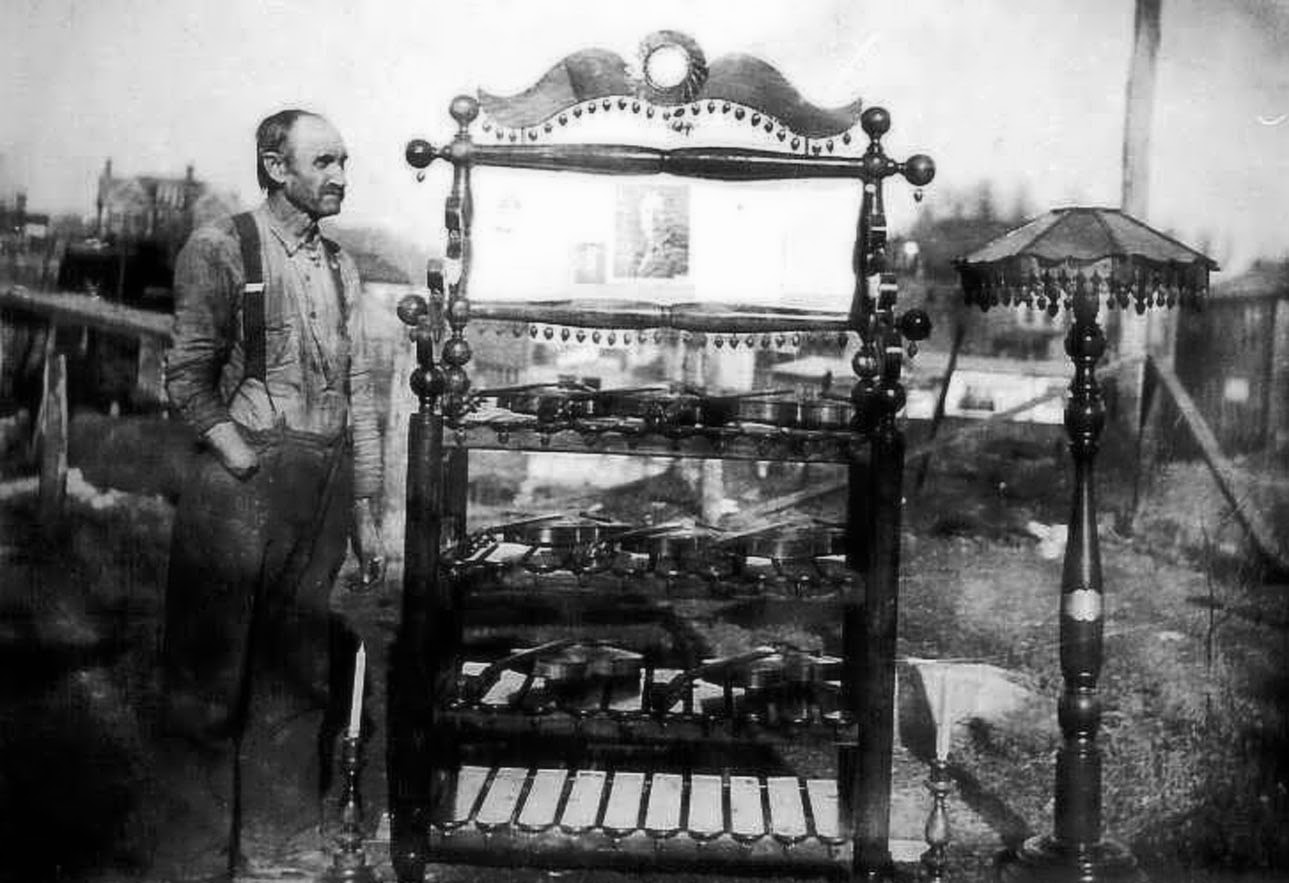
John E. Hale displaying many of the fiddles and furniture
he crafted by hand.
woodworking and cabinet making. He was much more than just a planing mill operator, he was also a craftsman of fine, intricate furniture and varied musical instruments, both before and after he lost his right arm. People from all around the region sought him out to build furniture for their homes. Likewise, musicians requested instruments of many types - fiddles, mandolins, banjos. Papaw loved playing these instruments too, especially the fiddle. Even without his right hand to hold the bow, Papaw would simply insert his stump between the wood stick and the hair, sawing away. One of his favorite tunes was “Turkey in the Straw.” He would take his fiddle with him on social occasions, like when he and some of the town’s men gathering at the jail to guard prisoners. Papaw would serenade them with a tune.

As much as John was known for his furniture and instruments, he was even more well-known for giving
William Jennings Bryan
them away - and to whom he gave them away. He particularly admired American leaders and fellow inventors. He gave one of his violins to Thomas Edison. More than one piece of his furniture was sent to Presidents and remained in the White House during their terms. But the man he admired most and who was the recipient of my grandfather’s generosity was William Jennings Bryan, the great Democratic orator. Grandpa sent Bryan a beautiful, handcrafted rocking chair while he was serving as Secretary of State under President Woodrow Wilson. My grandfather attached a note to the chair which read, “From a One-armed Mechanic. Bryan sent a gracious response of thanks, which made John very happy. Over the years, he received many such letters of thanks and appreciation for the gifts that he sent.

John E. Hale just prior to his death in 1943.
Following a long trip to California to visit his oldest son, Kingsley, Papaw returned to Wise County a very sick man. Cora and his family cared for him, but age and ill health had taken its toll. John Hale died on October 20, 1943 in the home that he and Cora build. He was buried in a hand-crafted coffin, made from Papaw’s favorite wood - black walnut. He was buried in the Wise County Cemetery, not far from his house. He was buried beside two of his children with his first wife, Burnith and Timothy, both of whom had died in childhood. His grave is not far from his old colleague and nemesis, Doc Taylor, whose grave is now marked.

Wednesday, October 8, 2014

The Storyteller Who Dipped Snuff

Cora Lee Hale, abt. 1970
October 8, 2014

Dear Constant Readers,

This is the sixth installment in an ongoing series of posts from which I hope will form the first draft of a book.  The working title for this book is, "Confessions of a Second Grade Failure."  It is a coming-of-age memoir about growing up in Kingsport, Tennessee during the 1960s and early 1970s.

And don't forget - if you subscribe to receive my blog posts by email before October 15, you will automatically be registered in a contest to win a new Kindle reader from Amazon.  For more details about the contest and how to subscribe, please read this post.

Cheers,

Stephen

P.S. Even though I do proofread my work before publishing on this blog, occasionally a grammatical error or misspelling will elude my notice.  I do have a more objective proofreader, my wife, Lynn, but she usually proofs it after it has gone out to you, the reader.  When I finish a blog, I transfer what I have written into chapters kept in a text document.  These blog posts help shape what I will soon submit to the literary agent.  So, if you find grammatical errors or misspellings, feel free to share them with me so that I may correct them.  Right now I am writing to generate material and content for the book, so I am somewhat less attentive to the polishing process that goes into finished material.  Thanks for your understanding and your participation.

_______________

Confessions of a Second Grade Failure

The Storyteller Who Dipped Snuff

My maternal grandmother was Cora Lee Hale. After the death of her husband, she lived with our family until her own death in 1971. As I child, I cannot remember a time when she was not present in my life. It was like having two mothers - one who gave actual birth to me and another who gave birth to my spirit.

When I remember my grandmother, Cora, the image that most immediately comes to mind is of her
Cora Hale and Stevie Rhodes
sitting in a green sofa chair in our living room near the fireplace. She has on her favorite blue print dress with knee-high stockings and comfortable low heel shoes. She is wearing a pair of dark, horn-rimmed glasses, though they do her little good - her eyesight failing as a result of advanced diabetes. Her gray hair is pulled back into a bun. She keeps a small tin can close by. It is filled with the brown power of Bruton’s Scotch Snuff, a tobacco that she frequently dips. And her black leather Bible, worn by years of reading, laying next to her on a small table.

Cora was a mountain woman from Appalachia. Her parents, Mickleberry Townsend and America Sparks, were from a long line of eastern Kentuckians who lived in the counties of Wolfe, Breathitt, Owsley and Estill. Cora herself was not born in Kentucky, but in Lawrence County, Missouri on July 19, 1886. Her extended family, along with many other Kentuckians, had migrated west in the early 1880s in the quest for new lands and new beginnings. But the Townsend family’s sojourn was brief. The West was not for them. The eastern hills beckoned them back home. By the 1890s, they were in Kentucky once more.

Mickleberry, Cora’s father, wore a long black beard and moustache above which were set a pair of
Mickleberry and America Townsend
with children
penetrating eyes. He was a farmer and a stove mill operator. America, her mother, raised their seven children and helped Mickleberry on the farm.

My grandmother was a natural storyteller. She loved to tell stories, especially about her childhood and adolescence in Kentucky. She and her younger sister, Lulie, were forever competing over the local boys. Mamaw said that whenever she would bring a boy home to court her, Lulie would just as quickly steal him away from her. Even so, being sisters was a stronger bond than any potential suitor - and besides, there were plenty of boys to go around.

Another story that Mamaw often told also involved her sister, Lulie. This was the story about the visitation of a spirit. She told me how her childhood best friend, a girl who lived the next farm over, became seriously ill - smallpox, if I remember correctly. Just before her illness, Cora and the girl had an awful argument. They ended up refusing to talk to each other. But as her friend’s illness grew progressively worse, she asked for Cora to come visit her so that they could make up. Cora admitted that, at that age, she had a stubborn streak and refused to go. She would make up with her friend when she was good and ready. Sadly, that time never came. The little girl died without the two of them reconciling. Cora was overwhelmed with grief, blaming herself for her friend’s death, berating herself for being so stubborn. Weeks and months went by before life seemed to return to normal, nevertheless the death of her dear friend continued to weigh on her.

One day, Cora was outside her house putting up laundry to dry in the sun. It was a bright, sunny day and no breeze was blowing. Suddenly, everything seemed to grow unnaturally still. Then Cora heard

something moving. It was the sound of her swing attached to a limb on a nearby tree. Slowly, Cora turned around to see why the swing was moving. It was then that Cora saw her - her best friend, the little girl who had died. She was sitting in the swing. Backwards and forwards the swing went with the little girl’s feet pumping in the air. She smiled at Cora, who was so startled that she dropped her basket of laundry. Cora was certain that this must be something that she was imagining. Her grief was surely causing her to see things that weren’t there.

Cora’s thoughts of self-doubt were interrupted by a scream from the kitchen. It was the sound of her sister, Lulie, who was at the sink washing dishes. She, too, had heard the swing and looked out the window, thinking that she would catch her older sister shirking her chores. But instead, she saw the dead girl, too. As soon as Lulie rushed out the kitchen door to get a better look, the apparition of the little girl quickly faded and the swing came to a stop. Cora and Lulie, both shaken, fell into each other’s arms and cried.

Later that night before going to sleep, they talked about what they had experienced. They agreed that it had indeed been the spirit of Cora’s dear friend come to visit them, but not to haunt them. Cora believed that it was a sign of forgiveness on the little girl’s part - that she released Cora from her sense of guilt and shame. At least that’s how my mamaw interpreted her visitation of the dead. For her, it was a moment of heaven-sent grace. That same night, she committed herself to never being so stubborn again.

My grandmother swore that this story was absolutely true, which only added to my own anxiety as a child upon her telling of the tale. Mamaw was no stranger to the supernatural. She had seen many things in her life which were not easily explained or understood. As I grew up under her love and care, my world was imbued with the uncanny and mysterious. She taught me that “we walk by faith, not sight” (2 Cor. 7, NRSV) - and that faith means trusting that reality is always bigger than your own perception of it.

Another of my grandmother’s favorite stories to tell was about how she came to be married. Her older
Jim and Nannie Hale
sister, Nannie, had married a man from Wise, Virginia in 1898. Nannie was older than Cora by eight years. Nannie’s husband was Jamerson Hale, better known as “Jim.” He and his older brother, John Edward Hale, ran a planing mill and lumber business together back in Wise. After the wedding, Nannie moved there with Jim. In 1901, Jim’s brother, John, was separated and soon divorced from his first wife, Emma Baldwin, with whom he had two children: Napoleon Kingsley and Dewey Hobsan Hale. John was grieved at the divorce and filled with regret. His worry about it was constant - so much so that one day, while working at the mill, he lost his concentration and thus lost his right arm in an accident. He was left to raise two boys with only one remaining arm. Being a man of considerable determination, he overcame his handicap, continued to work at the mill and raised his sons. But John was lonely, and he needed help caring for Kingsley and Dewey.

Within a couple of years or so, Nannie began to talk to John about her younger sister back home in Kentucky. She had turned nineteen and her parents had begun to worry that she might be getting too old to marry. Nannie told John that Cora was pretty and also a hard worker, that he should consider her as a potential wife. It wasn’t long before he began making trips to Kentucky to see Nannie’s sister. He courted her off and on for a short time. They got along well, enjoying each other’s company.

After a time, John talked to her father, Mickleberry, about the possibility of marriage. There was,
John Edward Hale
however, an issue of age. John was only ten years younger than Mickleberry himself, and there was a distance of twenty-four years between he and Cora. She was all of a teen and he was a middle-aged man of forty-three. But neither John nor Cora seemed to mind much the difference in their ages. So it was up to her father. Mickleberry and John talked man-to-man and reached a mutual agreement. So you see, my grandparents’ marriage was somewhat of an arranged affair, as many mountain marriages were at that time. But the difference in this instance is that Cora was very willing to marry John and quickly consented to their agreement.

Now there was one person who was not happy about the impending nuptials - and that person was America, Cora’s mother. To say that she was mad about the arrangement is to put it mildly. The reason for her anger had to do with John’s age. Why was Cora agreeing to marry this “old man”? What was Cora getting herself into marrying a man who is old enough to be her father and already with two sons? Weren’t there other suitable men who were closer to Cora’s own age?

America was so furious that on the day of the wedding, she grabbed Cora, slinging her across her knee
Cora Lee Townsend, wedding picture
and gave her a serious spanking. Cora cried and cried that her mother had treated her this way, and on her very own wedding day. Nevertheless, she was determined. She pulled herself together and got ready for the ceremony. The wedding took place at the Townsend home place in Horntown, Kentucky on June 19, 1905. The service was lead by a local preacher, Rev. B. M. DeWitt. Cora was now a married woman, and ready to leave home in Kentucky for her new life in Virginia with John.

Together, John and Cora built their own house in Wise, just a block from downtown. Their method of construction was that John held the wood in place with his left hand, Cora positioned the nails and John pounded them into place with a hammer strapped to the stump of his right arm. Board by board, window by window, door by door, John and Cora built a home to hold their new family. They would eventually have eleven children together - nine of whom lived to adulthood. The house that they build was filled with children, and their home was filled with love.